Week 2 Math and Art
As an aspiring science fiction writer, reading Flatland by Edwin A. Abbott was a deeply engaging look at the blending of art and mathematics. I was struck by how the author used the principles of geometry to not only imagine a rational two-dimensional and one-dimensional world, but also create entire functioning societies revolving around the unique challenges of such limited existences. From the simple mathematical idea of a flat plane, Abbott imagined a civilization with its own unique culture, history, and politics, all following logically from the math of two-dimensionality. As different as Flatland is from our world, Abbott also made it eerily familiar by his depiction of Flatland's rejection of the idea of higher dimensions, ultimately reflecting the flaws of our own society in the seemingly alien mirror of Flatland. In my own stories, I love to incorporate all sorts of complicated technologies and arcane magic systems, but Abbott showed me that even simple geometry is capable of creating novel, interesting, and relevant art.
 |
| Geometry of Flatland. Taken from wired.com |
Despite my ignorance of the visual arts, I felt like it should still have been obvious that mathematics had an intimate relationship with painting and drawing, but I was genuinely surprised by how many influential artists of the past also did important work with math. Things like vanishing lines, perspective, and the golden ratio, as well as the math based art of artists like Nathan Selikoff, convinced me that even art, at the end of the day, is fundamentally about numbers and their relationships.
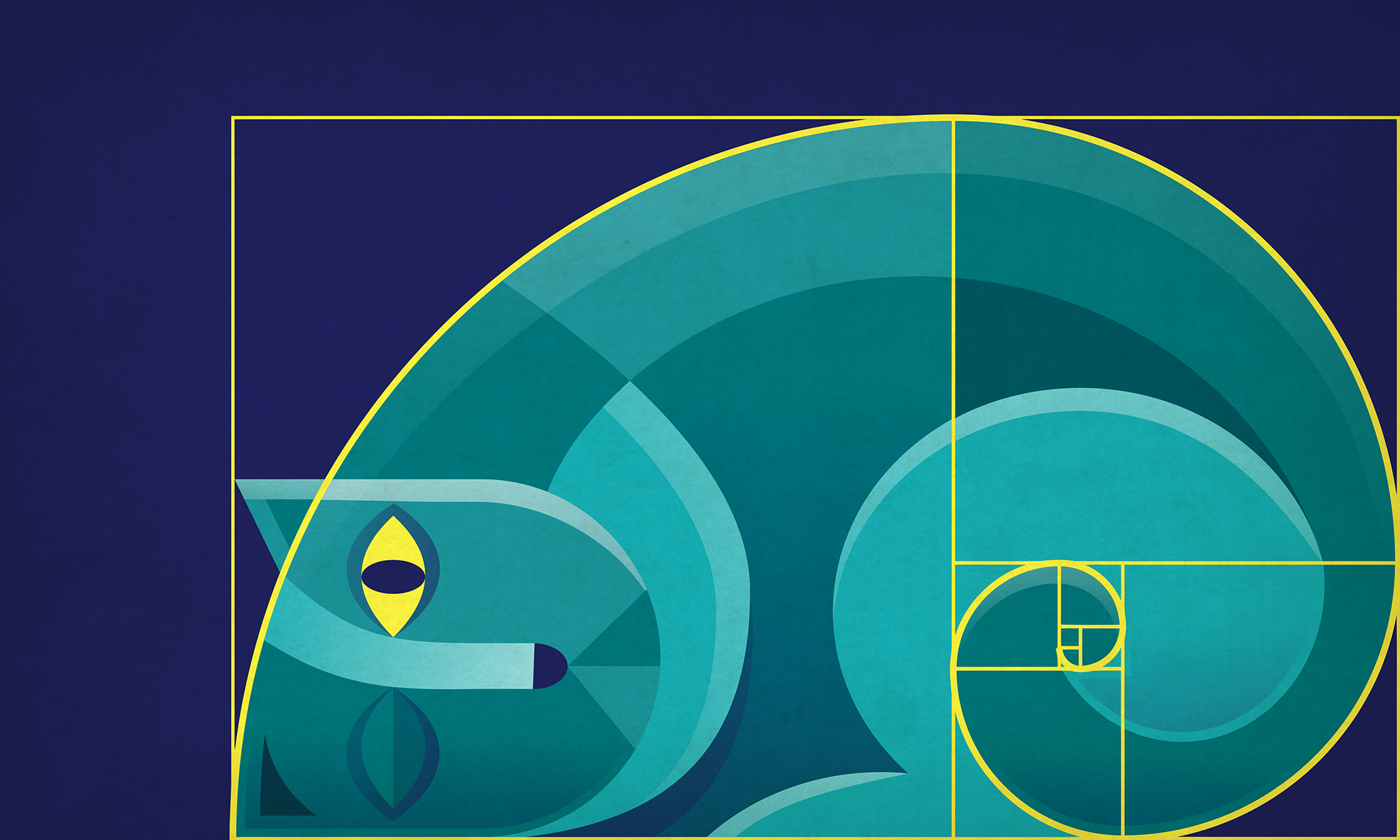 |
| Golden Ratio in Art. Taken from 99designs |
All this makes me wonder how mathematics can be applied to writing, and if concepts like the golden ratio could be used in some way to organize the chapters of a book in a more harmonious way. I particularly love the look of fractals, and I'm wondering if certain books could be described as a fractal, where each subplot is a microcosm of the overarching plot, where each character's inner conflict is a tiny image of the conflict in the book's world.
 | ||
| An example of fractal art. Taken from Wikipedia |
Based on what we've learned this week, I'd say that math and science are more or less essential to art. If art is a reflection of the world around us, math and science is how we can describe the world, and thus math and science help us make art. Like it or not, knowing math makes you a better artist, and probably a better writer as well.
Sources:
Abbott, Edwin A. Flatland, 1884, www.ibiblio.org/eldritch/eaa/FL.HTM. Accessed 9 Apr. 2021.
Frantz, Marc. "Lesson 3:Vanishing Points and Looking at Art." University of Central Florida, 2000, http://www.cs.ucf.edu/courses/cap6938-02/refs/VanishingPoints.pdf. Accessed 9 Apr. 2021.
Selikoff, Nathan. Nathan Selikoff. https://nathanselikoff.com/. Accessed 9 Apr. 2021.
Vesna, Victoria. “Mathematics-pt1-ZeroPerspectiveGoldenMean.” YouTube, 9 Apr. 2012, https://www.youtube.com/watch?v=mMmq5B1LKDg&feature=emb_title.
Weisstein, Eric W. "Mandelbrot Set." MathWorld, https://mathworld.wolfram.com/MandelbrotSet.html. Accessed 9 Apr. 2021.
Image Credits:
Bailey, Jennifer. “The Golden Ratio: How to Use It in Your next Design.” 99designs, Vistaprint, 23 Mar. 2020, 99designs.com/blog/tips/the-golden-ratio/. Accessed 9 Apr. 2021.
Doval, Valero. "A Guide to Flatland: What It's Like to Live in Two Dimensions." Wired. Conde Nast Publications, 20 Nov. 2014, https://www.wired.com/2014/11/geometry-of-flatland/. Accessed 9 Apr. 2021.
“Fractal Art.” Wikipedia, Wikimedia Foundation, 27 Mar. 2021, en.wikipedia.org/wiki/Fractal_art. Accessed 9 Apr. 2021.

Hi Jeffrey!
ReplyDeleteI loved that you covered a lot of bases in your blog. You talked about Art and Science, Art and Math, and gave many examples. Your conclusion is what really stood out to me. I loved how you phrased it! The connection you made with art being a representation of the world around us which is composed of math and science. Both art and writing are grounded in the surrounding and world we live in, thus is essentially understood through science and math. I thought it was a brilliant way to summarize this week's topic. Great work!