Week 6: Biotech + Art
This week, we looked at how biotechnology has been used for new and increasingly fantastic kinds of art. On a purely emotional level, I was most amused by the concept of the Blood Wars, where an artist pit the white blood cells of different people against each other in a massive/tiny tournament.
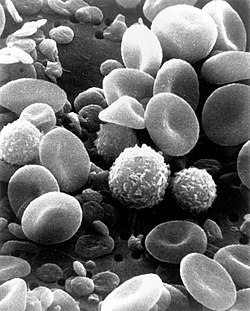 |
| Blood Cells Taken from Wikipedia |
But bioart is also intellectually fascinating to me because of how it forces us to rethink our outdated definitions of many concepts that might have initially seemed unambiguous. As Ellen K. Levy wrote in her article on the subject, biotechnological art forces us to ask what can be considered life and brings up difficult questions regarding the ethics of creating and modifying life and whether individuals should be able to own the life they modify. I was intrigued by her description of the attempts to simulate evolution, and the difficulty of doing so without imposing the prescriptions of the designers on the method to determine fitness, but my interest was really piqued by the debate surrounding whether engineered organisms and biological art can be patented, copyrighted, or owned. I can't say which side I fall on myself, but I certainly believe that with the coming wave of biotechnological innovation and DIY biology, as described by Chris Kelty, these questions have to be resolved soon.
 |
| Taken from GeneWatch.org |
Beyond how us humans will be affected by biotechnological art, another big question is whether it is ethical to modify organisms for "trivial" reasons, like the rabbit engineered to glow by Eduardo Kac. To me, it seems that if we can justify slaughtering and eating animals, simply engineering them to look pretty doesn't even come close to constituting a crime-- though of course, vegans would probably argue neither is acceptable. But if harming our fellow organisms with biotechnology is a crime, does that make helping them with biotechnology an obligation? Despite our best efforts, we do not have a monopoly on causing animal suffering-- nature itself creates limitless suffering as animals hunt and murder each other in the endless battle for food. If animals have enough moral consideration for us not to eat them, if we had the biotechnology to modify the life around us to lessen the suffering they experience-- to gentle the bloodiness of nature and turn the world around us into a Disney-esque paradise-- would we not be obligated to do so?
 |
| A glow-in-the-dark kitten Taken from livescience.com |
Works Cited:
Levy, Ellen K. “Defining Life: Artists Challenge Conventional Classification.” DESMA 9, UCLA, cole2.uconline.edu/courses/1669262/pages/unit-6-agenda?module_item_id=76758681.
Kelty, Chris. "Meanings of Participation: Outlaw Biology?" DESMA 9, UCLA, cole2.uconline.edu/courses/1669262/pages/unit-6-agenda?module_item_id=76758681.
Kac, Eduardo. GFP BUNNY, www.ekac.org/gfpbunny.html#gfpbunnyanchor.
Vesna, Victoria. “5 Bioart pt1 1280x720.” YouTube, 18 Sept. 2013, youtu.be/PaThVnA1kyg.
Zaretsky, Adam. “ELECTRONIC MUTAGENESIS.” Emutagem, emutagen.com/index.html.
Image Credits:
“White Blood Cell.” Wikipedia, Wikimedia Foundation, 30 Mar. 2021, en.wikipedia.org/wiki/White_blood_cell.
“Patenting.” GeneWatch UK , www.genewatch.org/sub-531144.
Choi, Charles Q. “Glow-in-the-Dark Kittens Lend a Paw to AIDS Fight.” LiveScience, Purch, 11 Sept. 2011, www.livescience.com/15994-glow-dark-cats-aids-virus-research.html.

Hi Jeffrey, I love the discussion of the ethical dilemma you presented in this blog post! I agree with you that it is indeed difficult to take a side on the debate and it seems that most of the public is divided on this issue as well. However, I believe that the debate should be explored in-depth by experts and artists alike, especially at the rate that biotechnology is advancing, in order for scientists and artists to be accountable to the public. As for your last point, I think it is difficult to argue that we have an obligation to 'save' other living organisms with biotechnology because it would take resources and realistically, few would have the vested interest in doing so, and also as we are interfering in nature in ways that are unseen and might be harmful to the ecosystem. -Audrey Tey
ReplyDeleteYou raised some great points here that I also kind of talked about with the ethics and questions regarding biotech and art. I also could not give any definitive answers to these debates, but you blog has given me more to think about on the topic. It is true that killing and eating animals would usually be considered worse than making them glow, but it becomes an interesting situation when considering the overarching topic of genetic manipulation and the benefits of each. I don't really know enough to put forward a stance on this, but there is a lot to discuss for sure, and you are right when you say these questions will have to be answered.
ReplyDeleteI really liked how you brought up the point about ethics when it comes to biotech and modifications of life. In the STEM field, sometimes humanities aspects can be overlooked because of the strong focus on data and facts. I also think the when you brought up ethics it was also a good connection to art and the arts in general.
ReplyDelete